
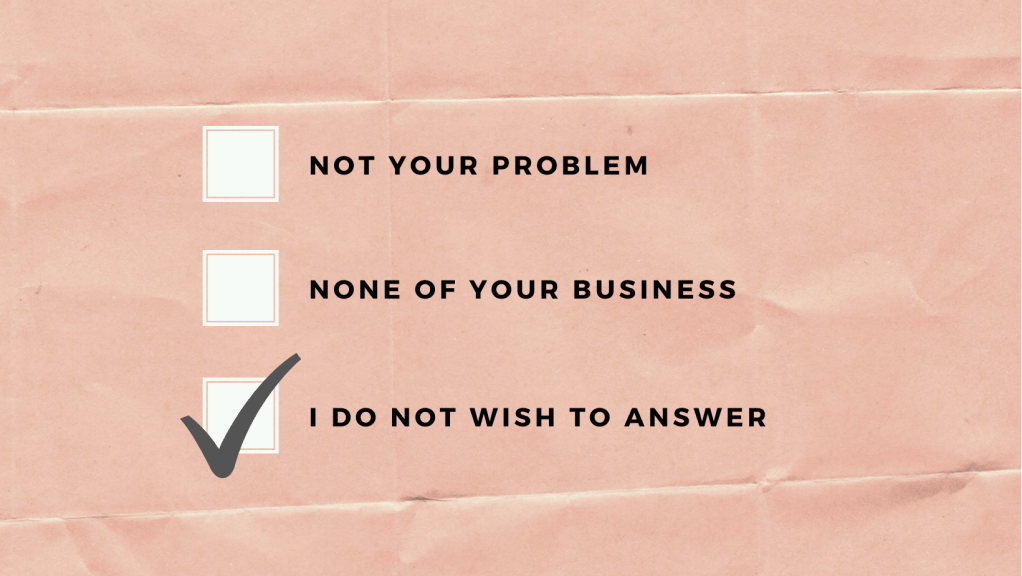
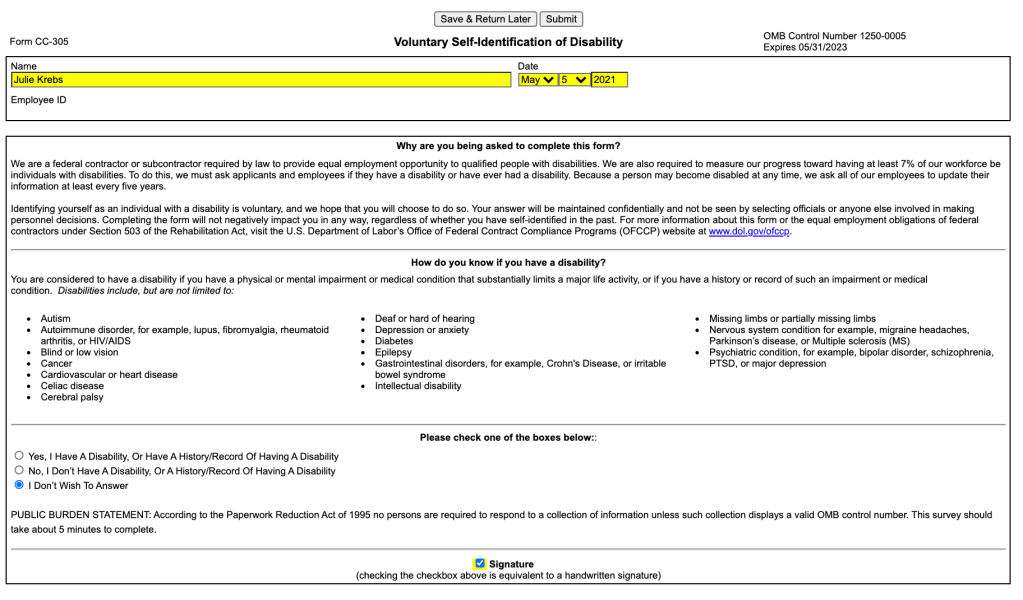
Perhaps it’s rheumatoid arthritis, having low vision (due to optics and height), having PTSD, or absolutely nothing at all, my point: you’ll never know. I do not wish to answer your Voluntary Self-Identification of Disability Form CC-305.
The year is 1973. The Rehabilitation Act of 1973 civil rights law has just been enacted to prohibit the discrimination on the basis of disability. It is the first major legislative effort to create a more equal opportunity for individuals who identified with having a disability. Cool! No program receiving federal funds can discriminate against a person with a disability, similar to the recent civil rights laws created to protect women and minorities. Disabilities are beginning to become a societal responsibility and regulations are being created to prevent judicial interpretation of the Rehabilitation Act. This was partly inspired by the soldiers returning from war who suffered PTSD and were missing limbs, reaching all the way back to World War I. The rest of the passion rose from the social movements pushing for the rights of disadvantaged and disabled minorities. Since 1973, the Rehabilitation Act was amended in 1978, 1986, 1992, and 2015. 1990 came, and with it, so did the Americans with Disabilities Act. Similar to the Rehabilitation Act, employers are prohibited from discriminating against qualified applicants and employees with disabilities and are required to provide reasonable accommodations for such individuals. Currently, the Voluntary Self-Identification of Disability Form CC-305 is located at your nearest HR department for your convenience, but at what cost?
I believe that the Voluntary Self-Identification of Disability Form CC-305 is placed with good intentions. However, in today’s competitive job market and hostile, political atmosphere, I feel the urge to strategize and “not wish to answer.” I will never have full confidence in a company to not discriminate. While it is natural for a human to categorize people and objects as a part of normal cognitive behavior, bias and discrimination are a part of a long standing conscious and subconscious belief system that feeds on fear. From a human perspective, the fear refers to being different. From a corporate perspective, however, the fear is monetarily driven. Shocking, right? According to Merriam-Webster, the definition of disability is a physical, mental, cognitive or developmental condition that impairs, interferes with, or limits a person’s ability to engage in certain tasks or actions or participate in typical daily activities and interactions. When the government creates a form to be completed during a job application that explicitly states “disability,” assuming the company acquiring the form will view a disability as an “impairment” or “interference” isn’t far-fetched.
Section 503 of the Rehabilitation Act of 1973, as amended, states that the “OFCCP has established a utilization goal of 7 percent for employment of qualified individuals with disabilities for each job group in the contractor’s workforce, or for the contractor’s entire workforce” (§60-741.45 Utilization goals). When this percentage is not met, “the contractor must take steps to determine whether and where impediments to equal employment opportunity exist,” including outreach and recruitment efforts. I will word the following sentence as clear as possible: You do not have the ability to see what percentage of current employees at any given company qualify for having a disability. Out of the individuals who have expressed having a disability, to you personally: you do not know if they have informed the company through the Voluntary Self-Identification of Disability Form CC-305. An entity being required to have at least 7% of their employees qualify for a disability means absolutely nothing to you, as an individual applying for a job.
This past week I have been in touch with a potential employer, discussing job interviews and a presentation. I apologized for a late reply after not responding to her for an entire day. I had just got my second intra articular injection in my lower back and passed out the second I got back (no pun intended). I have a long-standing history with facet arthritis from years of dance and an on-again, off-again relationship with a broken back. In my reply, I dialed down the severity and stated that it would be my last injection, which isn’t not true. However, next the doctor is going to do a procedure called an “RFA.” It’s really not that big of a deal and you’re probably losing interest, but this makes me an inconvenience. If there is another potential candidate where it’s ceteris paribus, except I have a pain management doctor who I visit so often that we have inside jokes, who do you think the company is going to hire?
Let’s bring this to a grayer scale: you have bipolar disorder, and while you didn’t specify that, you checked the box on the CC-305 for having a disability. Bipolar disorder is a mental illness. Sure, there are medications, but there is no procedure that will manage it for a year, until it’s time for the next procedure. Your bipolar disorder brings anxiety, depression, and mania. It’s hard to track and your potential employer is all too familiar with it, because his son is also bipolar. The company you applied for is your dream job, and you meet all of the qualifications. The only thing you are unfamiliar with is their improper code of ethics. They looked at your “confidential” CC-305. The employer browses through your social media accounts and see your dedicated activism for bipolar disorder, and then he promptly emails you-
“We appreciate your interest in this position, but at this point we are moving forward in our hiring process with other applicants whom we believe more closely match the requirements for the position and needs of the department.”
I opted to include this in a paragraph further along for the same reason I “do not wish to answer.” I never have and never will be ashamed of the disabilities that qualify me to check a box on a piece of paper (or in this case, a computer screen). I am confident, competent, and collected (and subpar with alliteration). I have been through my fair share of battles, but I don’t want my scars and open wounds to be the reason people look away. I am not discouraged, and I believe that the activism for equality has led way to monumental changes and it won’t stop here – I just don’t believe we are at the point where we can confide in our job applications that some days we can’t get out of bed due to a physical or mental condition. I will continue to advocate for what others and I am growing through in and out of the workplace, but we need the opportunity to enter that office before we can make a difference.
 folio & fable Designs
Leave a comment